Pitching yourself as a virtual assistant shouldn’t feel gross or pushy. But if you’re staring at a blank email wondering how to sound professional without sounding like a used car salesman, you’re not alone. This post gives you the exact framework (and copy-paste templates) to pitch your VA services confidently—without the ick factor!
Table of Contents
Let’s talk about the part of being a virtual assistant that nobody warns you about: actually pitching yourself to potential clients.
You’ve set up your website. You’ve figured out your services and pricing. You’ve made your Instagram look semi-professional. But now you’re staring at a blank email screen, palms sweating, thinking, “How do I do this without sounding desperate or annoying?”
Here’s the truth: pitching doesn’t have to feel gross! You’re not a used car salesman trying to trick someone into buying something they don’t need. You’re offering a legitimate service that solves real problems for busy business owners.
In this post, I’m breaking down exactly how to pitch VA services in a way that feels natural, confident, and professional – no sleaze required!
Why Pitching Feels So Uncomfortable (And Why It Shouldn’t)
If the idea of pitching yourself makes you want to hide under a blanket, you’re not alone. Most new VAs feel this way.
Here’s why pitching feels so uncomfortable:
You’re afraid of rejection. What if they say no? What if they ignore you? What if they think you’re annoying?
You feel like you’re bothering people. Nobody wants to be “that person” sliding into DMs or sending unsolicited emails.
You don’t want to sound salesy. You’ve seen the cringy pitches in your own inbox, and you definitely don’t want to be that person.
You’re second-guessing your value. Imposter syndrome is loud, and it’s telling you that you’re not qualified enough to charge money for your services.
But here’s the mindset shift that changes everything:
You’re not selling. You’re offering a solution to a problem they already have!
Business owners are drowning in tasks. Their inbox is a mess. Their social media hasn’t been updated in weeks. They’re working 60-hour weeks and still can’t keep up.
When you pitch your VA services, you’re not being pushy. You’re offering help. You’re giving them their time back. You’re solving a real problem.
That’s not salesy. That’s service.
The Mindset Shift You Need Before You Pitch
Before you even write your first pitch, you need to get your head right. Here’s the mindset you need to have when pitching virtual assistant services:
1. You’re not begging for work. You’re presenting an opportunity. You have skills. You can save them time. You can make their life easier. That’s valuable.
2. Not everyone will say yes, and that’s okay. Some people won’t need your services right now. Some people won’t respond. Some people will say no. That’s not a reflection of your worth- it’s just part of the process.
3. A “no” today doesn’t mean “no” forever. Maybe they don’t have the budget right now. Maybe they’re not ready to delegate yet. But they might remember you in three months when things get busier.
4. The worst thing that can happen is… nothing. They don’t respond. They say no thanks. Life goes on. You send another pitch. No big deal.
5. Confidence comes from doing it, not from feeling ready. You’re never going to feel 100% ready to pitch. Send the email anyway. The more you do it, the easier it gets.
Got it? Good. Now let’s talk about how to actually write a pitch that works.
The 4-Part Framework for Pitching Your VA Services
Every good pitch follows the same basic structure. Whether you’re sending a cold email, a warm pitch to a referral, or a DM on Instagram, this framework works.
Part 1: The Hook (Show You Know Them)
The first line of your pitch needs to grab their attention and show that you’ve done your homework.
You’re not copying and pasting the same generic pitch to 100 people. You’re writing something specific to them.
Good hooks:
“I’ve been following your podcast for a few months, and I love how you break down marketing strategy in such a practical way.”
“I noticed you’re launching a new course next month – congrats! That’s such a huge undertaking.”
“I saw on your Instagram that you’re juggling client work, content creation, and running your membership. That’s a lot on your plate!”
Bad hooks:
“Hi! I’m a virtual assistant and I’d love to work with you.” (Generic. Boring. Sounds like spam.)
“Dear Sir or Madam,” (Please don’t.)
“I hope this email finds you well.” (It won’t. Delete this phrase from your vocabulary.)
The goal of the hook is to show that you’ve actually paid attention to their business and that this isn’t a mass email.
Part 2: The Problem (Call Out What’s Not Working)
Next, you need to call out a problem they’re likely experiencing. This shows empathy and positions you as someone who understands their world.
Examples:
“I know how overwhelming it can be to manage a full client load while also trying to keep up with Instagram, emails, and all the behind-the-scenes admin work.”
“Launching a course is exciting, but it also means a million little tasks – setting up email sequences, updating your website, coordinating with your tech team. It adds up fast.”
“When you’re wearing every hat in your business, things like inbox management and calendar scheduling can eat up hours of your week.”
You’re not making assumptions or being negative. You’re acknowledging a reality they’re probably feeling!
Part 3: The Solution (How You Can Help)
Now you present yourself as the solution. Be specific about what you can take off their plate.
Examples:
“I specialize in helping course creators manage their launches – everything from email setup to tech troubleshooting to customer support. I can take the backend tasks off your plate so you can focus on showing up for your audience.”
“I help busy entrepreneurs stay on top of their inbox, calendar, and client communication so they can focus on the work that actually grows their business.”
“I support podcasters with show notes, episode scheduling, guest coordination, and social media graphics – basically, all the stuff that happens after you hit ‘record.'”
Notice how specific these are? You’re not saying “I can do anything!” You’re showing them exactly how you can help with their specific situation.
Part 4: The Ask (Make It Easy to Say Yes)
Finally, you make it easy for them to take the next step. Don’t leave them hanging with “Let me know if you’re interested!”
Give them a clear, low-pressure next step.
Examples:
“Would you be open to a quick 15-minute call to talk about how I could support your launch?”
“If this sounds helpful, I’d love to send over a few examples of how I’ve helped other clients in your industry.”
“Let me know if you’d like to chat! I have availability this week if you want to hop on a quick call.”
“No pressure at all – but if you’re curious, here’s a link to my services page so you can see what I offer.”
You’re not demanding a response. You’re not being pushy. You’re just opening the door.
Where to Pitch Your VA Services
Now that you know how to pitch, let’s talk about where to pitch.
1. Cold email pitches Find business owners who fit your ideal client profile (coaches, podcasters, course creators, etc.) and send them a personalized pitch email. Yes, this works. No, it’s not spammy if you do it right.
2. Warm pitches (referrals and connections) If someone refers you to a potential client, mention the referral in your pitch. This immediately builds trust and credibility.
3. Instagram or LinkedIn DMs If you’ve been engaging with someone’s content for a while, you can send a friendly, non-salesy DM offering your services. Keep it short and conversational.
4. Facebook groups or online communities Some Facebook groups allow self-promotion or have threads where you can offer your services. Check the rules first, then post a quick intro about what you do.
5. Networking events (virtual or in-person) When you meet someone who could be a potential client, follow up with a friendly email referencing your conversation and offering your services.
6. Your own content Post on Instagram, TikTok, or LinkedIn about what you do. Share client wins, tips, and behind-the-scenes of your VA business. This attracts clients to you instead of you chasing them.
Templates and Examples
Okay, enough theory. Let’s get practical. Here are copy-paste templates you can customize and use today.
Cold Pitch Email Template
Subject line: Quick question about [their business/launch/project]
Hi [Name],
I’ve been following [your podcast/Instagram/blog] for a while now, and I love [specific thing you admire about their work].
I noticed [specific observation about their business—like they’re launching something, posting less frequently, or seem busy]. I know how overwhelming it can be to manage [specific task they likely struggle with].
I’m a virtual assistant who specializes in [your niche—like supporting course creators, managing podcasts, or helping coaches with admin tasks]. I help [type of client] with [specific services] so they can focus on [the big-picture work they actually want to do].
If this sounds helpful, I’d love to hop on a quick 15-minute call to see if we’d be a good fit. Here’s a link to my calendar: [Calendly link]
No pressure at all—just wanted to reach out!
Thanks, [Your Name]
Warm Pitch Email Template (For Referrals or Connections)
Subject line: [Mutual connection] thought we should connect
Hi [Name],
[Mutual connection] mentioned that you might be looking for some support with [specific task or project]. I’m a virtual assistant who specializes in [your niche], and I’d love to help if it’s a good fit.
I work with [type of client] to handle [specific services] so they can focus on [their zone of genius]. For example, I recently helped [quick client win or example].
If you’re interested, I’d be happy to chat for 15 minutes and learn more about what you’re working on. Here’s my calendar if you want to grab a time: [Calendly link]
Looking forward to connecting!
Thanks, [Your Name]
DM Pitch Template (Instagram or LinkedIn)
Hey [Name]! I’ve been loving your content lately—especially your post about [specific post or topic].
I’m a VA who helps [type of client] with [specific services], and I noticed you’re [specific observation about their workload or business]. If you’re ever looking for support with [task], I’d love to chat!
No pressure—just wanted to introduce myself. Feel free to check out my page if you’re curious about what I do!
Common Mistakes and Fixes
Mistake #1: Sending a generic, copy-paste pitch to everyone. Fix: Personalize every pitch. Mention something specific about their business so they know you’re not mass-emailing 100 people.
Mistake #2: Making the pitch all about you. Fix: Focus on them and their problems, not on how great you are. Your pitch should be 80% about them and 20% about you.
Mistake #3: Being too vague about what you do. Fix: Be specific! Don’t say “I can help with anything.” Say “I help course creators set up their email sequences, manage their tech, and handle customer support.”
Mistake #4: Not giving them a clear next step. Fix: Always include a call to action. Make it easy for them to say yes by offering a quick call, sending your portfolio, or sharing your services page.
Mistake #5: Giving up after one pitch. Fix: Most people won’t respond to your first pitch. That’s normal. Send 10 pitches. Then 20. Then 50. The more you pitch, the more clients you’ll land.
Mistake #6: Apologizing or being overly humble. Fix: Don’t say “Sorry to bother you” or “I know you’re probably too busy.” Be confident. You’re offering value, not asking for a favor.
Next Steps
Here’s what to do right now:
Step 1: Make a list of 10 potential clients. Think about who you’d love to work with (coaches, podcasters, course creators, small business owners).
Step 2: Do a little research on each one. Check out their website, Instagram, podcast, or LinkedIn. What are they working on? What might they need help with?
Step 3: Use the templates above to write personalized pitches. Customize each one so it doesn’t sound generic.
Step 4: Send the pitches! Don’t overthink it. Hit send and move on to the next one.
Step 5: Follow up if you don’t hear back in a week. A quick “Just wanted to bump this up in case you missed it!” can work wonders.
Remember: pitching gets easier the more you do it. The first one feels scary. The tenth one feels normal. By the time you’ve sent 50 pitches, you’ll wonder why you ever stressed about it in the first place.
You’ve got this!
Need more help getting your VA business off the ground? My 14-Days to VA Roadmap walks you through everything from naming your business to pitching your first client—all in 14 days. Or join VA Launch Academy for templates, pitch scripts, and live coaching as you launch!
Share This Post:
Email
Facebook
Pinterest
Twitter
You might also like...
Think email marketing is outdated? Think again. Building an email list is one of the most powerful ways to land consistent VA clients without chasing them on social media. This post breaks down exactly how to start, grow, and use your email list to fill your calendar with dream clients!
Pitching yourself as a virtual assistant shouldn’t feel gross or pushy. But if you’re staring at a blank email wondering how to sound professional without sounding like a used car salesman, you’re not alone. This post gives you the exact framework (and copy-paste templates) to pitch your VA services confidently—without the ick factor!
Struggling to keep track of client projects, deadlines, and your own to-do list? You need a project management tool that actually works for VA life. This post breaks down the best options (ClickUp, Asana, Trello, Monday.com, and more), what each one does well, and how to pick the right one for your business.
Wondering where to find virtual assistant clients when you’re just starting out? Forget job boards that pay $5/hour. This post breaks down 5 real places to find quality clients who actually pay what you’re worth—from Facebook groups to warm outreach. You’ll walk away with a game plan to land your first (or next) client!
Tired of competing on price as a general VA? Specializing as a virtual assistant lets you charge package rates, attract better clients, and actually scale your business. This post breaks down the best specializations to consider, how to learn the skills, and how to position yourself as an expert—even if you’re brand new!
Is being a virtual assistant worth it? If you want flexibility and real income without leaving your house, yes. But it’s not all laptop-on-the-beach vibes. This post breaks down the honest pros, the real cons, and who this career is (and isn’t) perfect for. You’ll walk away knowing if the VA life is your next move.
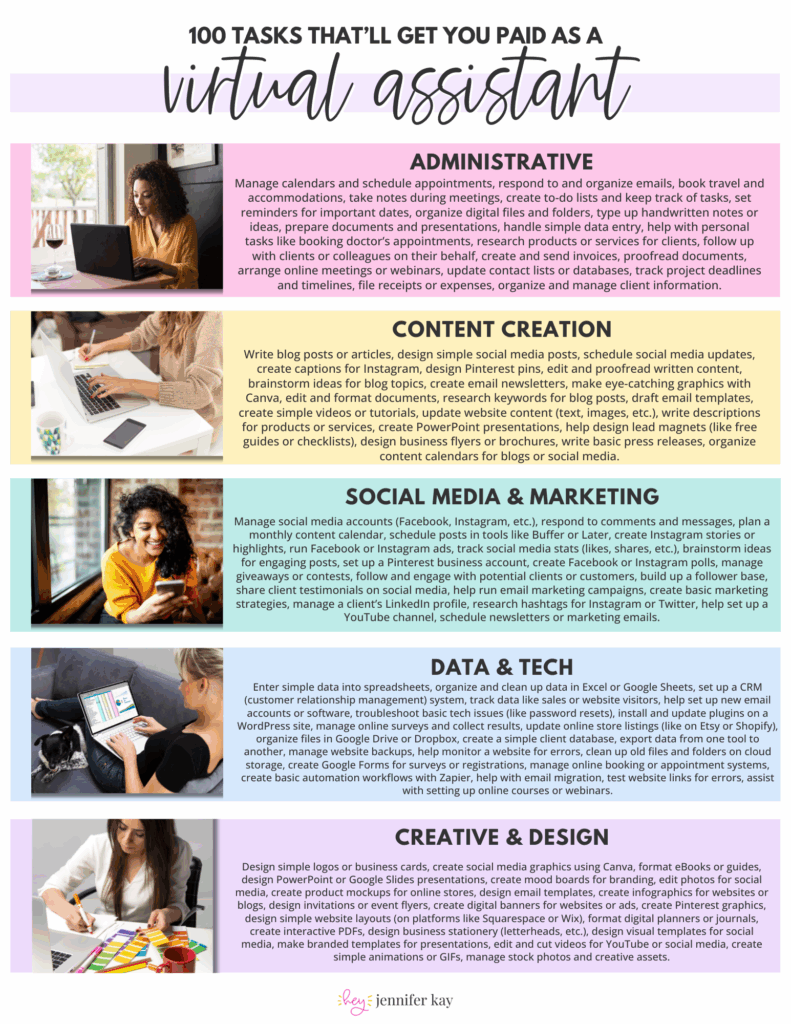
 100 Tasks VAs are Getting Paid to Do –